

.jpeg) Clark Edwards
Clark Edwards
|
Two questions come up on almost every chemical injection call I take. The first is "how much pressure does this pump really need to make?" The second is "the site has no power, can we run it on solar?" Both have a clean answer once you know the two or three numbers that decide it, and both get expensive when somebody guesses. |
This post covers what changes on a chemical injection pump once the line is over 1,000 psi, when a solar chemical injection pump is the right call, and how to spec either one. If you already know your line pressure and dose and just want it sized, call me at 337-252-6487 and we'll do it in ten minutes.
When Do You Need a High Pressure Chemical Injection Pump?
You need a high pressure chemical injection pump when the line you're injecting into runs above roughly 1,000 psi. The pump has to overcome line pressure plus the loss through the tubing, check valve, and quill, and still have margin left. If it can't, the chemical never lands and the pump just cycles against a closed door.
Where that shows up on the Gulf Coast:
-
Wellhead injection into the tubing or casing annulus for corrosion inhibitor, scale inhibitor, paraffin, and H2S scavenger. Tubing pressure on a flowing gas well can sit anywhere from 1,500 to 5,000 psi, and shut-in pressure runs higher.
-
Flowline and pipeline injection downstream of the choke, typically 500 to 1,500 psi, so this one sits on the fence and depends on your operating envelope.
-
Gas lift and capillary string injection, where the chemical rides down a small-bore line to the bottom of the well. Those routinely need 3,000 to 10,000 psi at the surface.
-
Methanol injection for hydrate control on high pressure gas lines, especially in winter.
Below about 250 psi you're in metering pump territory, and I covered that split in August. This post is about what happens above the line.
What Changes on a High Pressure Chemical Pump Above 1,000 psi?
Above 1,000 psi the pump stops being a diaphragm pump and becomes a packed plunger pump, and everything around it gets heavier. That's the short version. Here's what actually changes in the build:
-
Plunger instead of diaphragm. Mechanical and solenoid diaphragm pumps top out around 150 to 250 psi. Hydraulically actuated diaphragms can reach a few thousand psi, but at wellhead pressures the standard answer is a packed plunger running in a stainless or alloy fluid end.
-
Plunger and seal materials. Ceramic or tungsten carbide plungers with PTFE or graphite-filled PTFE packing. Plain stainless plungers score under high load and start leaking within weeks.
-
Fluid end metallurgy. 316 stainless is the floor. Hastelloy C for aggressive chemistries like strong acids or high-chloride brines.
-
Check valves. Suction and discharge checks are the whole pump at this pressure. They need hardened seats, and on oilfield chemicals a double ball check on the discharge is cheap insurance.
-
Discharge relief valve. Not optional. A positive displacement pump against a blocked discharge will find the weakest fitting. The relief gets set 10 to 15 percent above max operating pressure and routed back to the tank.
-
Tubing and fittings. Rated for the pressure with margin. 316 tubing in the right wall thickness, compression fittings rated for service, no PVC anywhere on the discharge side.
-
Injection quill with integral check. The quill puts chemical into the center of the flow instead of dribbling it down the pipe wall, and the check keeps line pressure off the pump when it stops.
Why does plunger size matter so much?
Because pressure and flow trade against each other through the plunger diameter. The same motor and stroke driving a smaller plunger makes more pressure and less volume. On a typical oilfield injection head you'll see something like this:
| Plunger diameter | Typical max pressure | Typical max flow (simplex) |
|---|---|---|
| 1/4" | ~5,000 psi | ~18 GPD |
| 3/8" | ~2,500 psi | ~40 GPD |
| 1/2" | ~1,250 psi | ~75 GPD |
Exact numbers vary by manufacturer and motor, but the shape of the table doesn't. If you need 5,000 psi and 75 GPD at the same time, that's not one small head. That's a duplex or triplex, or a bigger pump altogether, like the Udor triplex we put on the Turbo Chem skid to get 3,000+ psi at roughly 8 GPM.

How Do You Size a High Pressure Chemical Injection Pump?
You size a high pressure chemical injection pump from three numbers: the dose in gallons per day, the maximum pressure at the injection point, and the chemical itself. Get those three right and the pump picks itself.
-
Dose. Treatment rate in ppm times the fluid rate you're treating. A 25 ppm corrosion inhibitor dose on 2,000 barrels a day of produced water is about 2.1 gallons a day. Most wellhead doses land between 1 and 50 GPD, which is why these pumps are small.
-
Pressure. Take the highest pressure the injection point will ever see, including shut-in, not the normal flowing number. Add 10 to 20 percent for line loss and margin. That's your minimum pump rating, and the relief valve sets just above operating.
-
Chemical. Viscosity, freeze point, and compatibility. Cold paraffin inhibitor thickens and starves the suction. Methanol flashes and needs a flooded suction. Acids dictate the metallurgy.
Then pick a plunger that makes the pressure and lands your dose in the middle of its stroke range, not at 5 percent or 95 percent. A pump running at the bottom of its range loses accuracy, and one at the top has no room when the well changes. I went deeper on turndown in the metering vs. injection post, and the same rule applies here.
What Is a Solar Chemical Injection Pump?
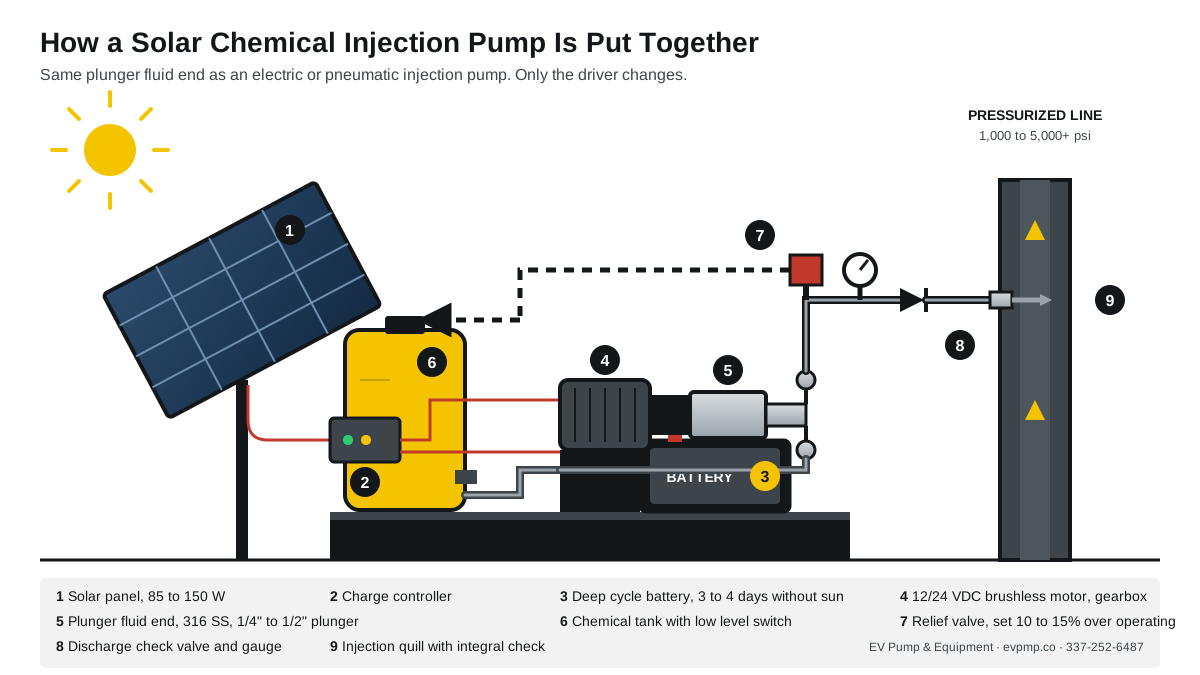
A solar chemical injection pump is a plunger injection pump driven by a 12 or 24 volt DC motor, powered by a solar panel and a battery so it runs day and night without grid power or gas. It's the same fluid end you'd put on an electric or pneumatic pump. Only the driver changed.
A typical package looks like this:
- Motor: brushless DC gear motor, roughly 1/15 HP for heads under 2,000 psi and around 1/4 HP for higher pressure heads.
- Panel: 85 to 150 watts for a single head, sized to the motor and how many hours a day the pump runs.
- Battery: deep cycle, sized for three to four days of run time with no sun so a string of overcast days doesn't stop the dose.
- Controller: continuous run or timed cycles, adjustable stroke, and on better units a serial port so SCADA can see it. Some include a heater loop for methanol in freezing weather.
- Fluid end: the same 1/4", 3/8", or 1/2" plunger heads in 316 stainless, simplex through triplex.
- Rating: Class I, Division 2 versions for wellsite installs.
Flow tops out around 150 to 200 GPD on the largest duplex and triplex heads, with most single-head units doing 1 to 75 GPD. Pressure runs up to 5,000 psi on small plungers, with a few high pressure options rated to 7,000.
When Is a Solar Chemical Injection Pump the Right Call?
Solar is the right call when the site has no grid power, the dose is under about 100 GPD, and you don't want to burn or vent well gas to run a pump. That describes most of the remote wellheads and pipeline injection points in South Louisiana and East Texas.
The reason solar has taken off in the last few years isn't the panels. It's the rules on gas-driven pneumatic pumps. EPA's 2024 methane rule for oil and gas (the OOOOb and OOOOc standards) requires zero-emission pneumatic pumps at sites with access to electrical power and pushes gas-driven diaphragm pumps at unpowered sites toward capture or control. Several states have gone further on their own. A gas-driven injection pump that vents to atmosphere on every stroke is a reporting problem now, and a solar pump makes it go away without running power to the lease.
Solar is the wrong call when:
- Your dose is over roughly 200 GPD, or you need high pressure and high volume at the same time. The battery and panel get too big to be practical.
- The pump has to run continuously at high load. Duty cycle drives panel size, and a 24-hour high pressure duty wants a real power source.
- The site is shaded, or you're far enough north that winter sun won't carry the battery.
- You're pumping a thick chemical cold. The DC motor has limited torque, and a starved suction will stall it.
Solar vs. pneumatic vs. electric: which one fits the site?
| Driver | Best fit | Flow / pressure | Watch out for |
|---|---|---|---|
| Solar / battery DC | Remote wells, pipeline injection, no grid, emissions-sensitive | 1–200 GPD, up to ~5,000 psi (7,000 on select heads) | Panel and battery sizing, winter, viscous chemical |
| Gas-driven pneumatic | Legacy sites, moderate pressure, no power | Up to ~3,000 psi | Vents gas every stroke, now regulated; freezing supply gas |
| Instrument air pneumatic | Plants and facilities with an air system | Up to ~3,000 psi | Needs dry air; none at a remote lease |
| AC electric | Powered sites, high flow, continuous high pressure | Any flow, 10,000+ psi | Needs power at the site; explosion-proof motor cost |
| Diesel skid | Portable high flow, high pressure (batch treating, skids) | GPM range, 3,000+ psi | Fuel, maintenance, oversized for a wellhead dose |
Can a Solar Pump Handle High Pressure Chemical Injection?
Yes, a solar chemical injection pump can handle high pressure injection, as long as you trade flow for it. A 1/4" plunger on a DC motor will make 5,000 psi, but it will only move about 18 gallons a day doing it. That covers most wellhead corrosion and scale programs. It does not cover a 100 GPD methanol job at 4,000 psi.
Three things to check before you spec solar for a high pressure line:
-
Motor size. Anything over about 2,000 psi wants the larger DC motor option, which pulls more current and needs a bigger panel and battery.
-
Duty cycle. A pump making 5,000 psi for a few timed cycles a day is fine on 100 watts. The same pump running 24 hours is not.
-
Relief and check valves. Same rules as any high pressure chemical pump. A relief valve set 10 to 15 percent above operating, a discharge check, and a quill check at the line. Solar doesn't change any of that.
If the numbers don't fit on one head, a duplex head on the same motor doubles the flow at the same pressure and is still a reasonable solar load. Past that, it's time to talk about running power or a small diesel unit.
What Makes High Pressure and Solar Injection Pumps Fail in the Field?
Most high pressure and solar injection pumps that come through our shop failed for one of five reasons, and none of them are the pump's fault.
-
Running dry. The chemical tote ran out, the suction lost prime, and the plunger ran against dry packing until it scored. Ceramic plungers survive this better, but nothing survives it for long. A low-level switch on the tank is the cheapest fix in this business.
-
Crystallized or gummed chemical in the checks. Scale inhibitor and some corrosion inhibitors dry to a solid when the pump sits. The check balls stick, the pump loses prime, and the operator turns the stroke up to compensate. Flushing before a shutdown prevents most of it.
-
Relief valve set wrong or missing. A blocked discharge, a closed valve at the quill, and the pump blows a fitting or splits a fluid end. We rebuild a lot of these.
-
Undersized solar package. The pump was sized for the dose, and the panel and battery were whatever came in the box. Comes December, the battery goes flat by 4 a.m. and the well runs untreated until noon. Size the battery for the worst week of the year, not the average.
-
Freeze. Methanol and water-based chemicals in the suction line during a hard freeze, or supply gas freezing on a pneumatic. Heat trace, insulate, or use the controller's temperature loop.
Packing and check valve kits are normal wear and should be on a schedule. Everything else on this list is preventable, and it's usually what we find when a pump comes in for a rebuild.
Need a high pressure or solar injection pump? Talk to Clark.
We size, sell, build, and rebuild chemical injection pumps out of our shop in Scott, Louisiana. That includes single-head solar units for a remote wellhead, high pressure plunger pumps for capillary and gas lift service, and full chemical injection skids with the pump, tank, relief, and quill already plumbed and tested. If you've got a line pressure and a dose, I can tell you what fits on the phone.
Call 337-252-6487 or send us the specs and we'll get back to you the same day.
Frequently Asked Questions
How much pressure can a chemical injection pump make?
Standard diaphragm chemical injection pumps make 150 to 250 psi. Pneumatic and solar plunger pumps reach 3,000 to 5,000 psi on small plungers, and a few high pressure heads are rated to 7,000. Electric and engine-driven plunger pumps for capillary and downhole injection run 10,000 psi and above. The plunger diameter and the drive decide the number.
What is the difference between a high pressure chemical pump and a chemical metering pump?
The technology is the same positive displacement principle. The difference is that a high pressure chemical pump is built around a packed plunger, hardened check valves, and rated fittings so it can land chemical in a line above 1,000 psi, while a metering pump is built for dose accuracy at low to moderate pressure. If your line is over a few hundred psi, you're buying an injection pump, whatever the catalog calls it.
How many gallons per day can a solar chemical injection pump deliver?
Most single-head solar injection pumps deliver 1 to 75 gallons per day depending on plunger size, and duplex or triplex heads on the same motor reach 150 to 200 GPD. Flow drops as pressure rises, so a 1/4" head at 5,000 psi does around 18 GPD while a 1/2" head at 1,250 psi does around 75.
How big a solar panel does a chemical injection pump need?
A single-head solar injection pump typically runs on an 85 to 150 watt panel with a deep cycle battery sized for three to four days without sun. Higher pressure heads, longer run times, and northern winters push the panel and battery up. Size for the worst week of the year, not the yearly average.
Do solar chemical injection pumps replace gas-driven pneumatic pumps?
Yes, that's the main reason operators are switching. A gas-driven pneumatic pump vents natural gas on every stroke, and EPA's 2024 methane rule along with several state rules now restrict that. A solar DC pump uses the same fluid end, makes the same pressure, and vents nothing, so it's the usual replacement at a remote site with no grid power.
Can EV Pump repair a solar or high pressure chemical injection pump?
Yes. We rebuild plunger fluid ends, replace packing, plungers, and check valves, and troubleshoot DC motors, controllers, and solar packages in our shop in Scott, Louisiana. If the pump is a total loss we'll size and supply the replacement, and if the site needs more than a pump we build the whole injection skid.
.png?width=151&height=80&name=Logo%20-%20EV%20Pump%20%26%20Equipment%20(5).png)
EV Pump & Equipment is a leading provider of high-performance fluid handling solutions, specializing in custom pump systems and comprehensive services for industries like oil & gas, petrochemical, and municipal water. With a deep passion for pumps and a commitment to excellence, we deliver reliable, efficient solutions tailored to meet the unique needs of every client. Our hands-on approach and elite equipment ensure that your operations run smoothly and efficiently, every time.