Skip to the main content.

Who We Are

Trusted to fix what others can’t.

Based in Lafayette and trusted across the Gulf Coast, we bring real-world experience to every job and build long-term trust with the people running it.

Comprehensive Pump & Equipment Solutions

If it rotates, moves fluid, or needs fixing, we’ve got it covered.

From pump repair and rebuilds to custom machining and hard-to-source parts,
we’re the team you call when no one else can figure it out.

"
We believe our impact goes beyond pumps. The energy and industrial sectors are crucial to global development, and we’re proud to contribute with our expertise and broad vision.

- Clark Edwards, Owner

10 min read

Chemical Metering Pump vs. Injection Pump: How to Pick the Right One


Two people can describe the same pump and call it two different things. In the oilfield, it's an injection pump; in a water plant or a process building, it's a metering pump. That's fine until you're buying one - because the pump on the shelf labeled for the other job will either fail on your line or quietly deliver the wrong dose for a year.

Clark walks through what actually separates a chemical metering pump from a chemical injection pump, what "±1% accuracy" really buys you, and how to spec the right one.


Is a Metering Pump The Same As An Injection Pump?

No, a metering pump is not the same as an injection pump - but the difference is the application, not the technology.

A chemical metering pump and a chemical injection pump are both positive displacement pumps that push a fixed volume of chemical forward on every stroke, which is why the terms get swapped so freely. What separates them in practice is the discharge pressure they're built to work against and how tight the dose has to hold.

A chemical metering pump is built to keep a dose inside a specified accuracy band at low to moderate pressure - treating water, feeding reagent into a process line, running a pH loop. A chemical injection pump is built to get chemical into a line that's already under high pressure, where landing the dose at all is the harder half of the job. You pick between them with two numbers: your discharge pressure and how much dose error your process can absorb.


What Is a Chemical Metering Pump Used For?

A chemical metering pump is used anywhere a measured volume of chemical has to enter a process continuously and repeatably, at pressures a plant or treatment system actually runs at. Around here that's four kinds of work.

  • Water and wastewater treatment. Sodium hypochlorite for disinfection, caustic or acid for pH correction, antiscalant ahead of membranes, coagulant and polymer at the head of the plant. Most of it paced to influent flow, and most of it tied to a number somebody has to report.

  • Chemical processing and blending. Reagent, catalyst, and modifier metered into batch reactors and continuous lines. This is where accuracy specs get read closely, because dose error shows up as off-spec product rather than as a pump problem.

  • Boiler and cooling water treatment. Oxygen scavenger, phosphate, corrosion and scale inhibitor, biocide. Small flows, continuous duty, and the consequences of drift are slow and expensive.

  • Low-pressure production and facility work. Tank batteries, saltwater disposal, gathering facilities — anywhere the injection point is downstream of pressure rather than at a wellhead.

The common thread is that nobody watches these pumps. They run in a corner of a building or on a pad, they don't alarm when they drift, and the first indication that the dose is wrong usually arrives as a lab result.


Chemical Injection Pump vs. Metering Pump

Both are positive displacement. Everything below is what changes when you move from metering duty into injection duty — and it's more than the pressure rating.


  Chemical Metering Pump

  Chemical Injection Pump

What you're dosing into Open channel, atmospheric tank, or a process line at plant pressure A live line already under pressure — wellhead, flowline, trunk line
Typical discharge pressure Under ~250 psi, often far lower

300 to 10,000+ psi

What the spec is written around Dose accuracy and turndown

Pressure rating and reliability against back-pressure

Accuracy expectation Held to a stated band — ±1% steady-state on an API 675 pump

Accurate, but pressure capability usually drives selection first

Common designs Solenoid diaphragm, motor-driven diaphragm, peristaltic

Packed plunger, hydraulic diaphragm, pneumatic

Typical wetted materials PVC, PVDF, PTFE, 316 SS

316 SS, Hastelloy C, PTFE

Driver and power Electric, almost always available on site

Electric, pneumatic, solar, or diesel — power is often the constraint

Control 4–20 mA flow pacing or closed loop on a measured variable

Often timer or manual stroke — many sites have no instrumentation

Install Wall, shelf, or panel mount, indoors, attended

Skid-mounted, outdoors, frequently unmanned

Governing standard API 675 where accuracy is contractual

API 675 plus piping and relief design to the pressure class

Failure mode when mismatched Put on a pressurized line, it can't build head and delivers nothing

Put on a low-pressure dosing job, it won't turn down far enough to hold the dose

Where does "dosing pump" fit?

Dosing pump is the same category again, used mostly in European specs, lab work, and OEM equipment. It usually implies small, controlled additions at low pressure — solenoid diaphragm or peristaltic. If a vendor quotes you a dosing pump for a process line, read the discharge pressure rating before you read anything else.


How Accurate Are Chemical Metering Pumps?

A chemical metering pump built to API 675 holds steady-state accuracy within ±1%, linearity within ±3% of rated flow, and repeatability within ±3% of rated flow, across a turndown ratio of at least 10:1 that can be adjusted while the pump is running. Those four numbers are the actual definition of a metering pump. A pump that can't hold them is a transfer pump with a knob on it.

Steady-state accuracy, linearity, and repeatability aren't the same thing

Vendors quote whichever one flatters the pump, so it's worth knowing which is which.

  • Steady-state accuracy — how far actual flow sits from the set point while conditions hold constant. This is the ±1% number.
  • Linearity — whether the flow-to-setting relationship stays a straight line across the range. A pump can be dead accurate at 100% and 50% and still sag at 20%.
  • Repeatability — whether the pump returns to the same output when you set it back to a previous setting. This is the one that matters if anybody adjusts the dose seasonally.

Why turndown is where accuracy actually goes

Here's the part that catches people. That ±1% is measured against the pump's rated capacity, not against whatever you've dialed it down to. Take a metering pump rated 50 GPH. At full stroke, ±1% is ±0.5 GPH — nothing. Turn it down to 5 GPH because that's what your dose actually calls for, and the allowable band is still ±0.5 GPH. Now it's ±10% of the dose you're trying to hold.

So a turndown ratio quoted without an accuracy figure attached to it is meaningless — any pump turns down to zero eventually. The number to ask for is the minimum capacity at which the pump still meets its stated accuracy. And the practical takeaway is the opposite of what most people assume when they buy: an oversized metering pump running near the bottom of its range is less accurate than a correctly sized one running in the middle of its range. Size to the middle, not to the ceiling.

How do you turn a target dose into a pump size?

For volumetric dosing into produced fluid, the arithmetic is short:

Chemical gallons per day = (target ppm × barrels per day × 42) ÷ 1,000,000

Twenty ppm of corrosion inhibitor into 1,000 BPD works out to 0.84 gallons per day. Then run the same math at your minimum and maximum throughput, not just the nominal — the spread between those two is your required turndown, and it's the number that eliminates most of the catalog before you ever open it. Add discharge pressure (line pressure plus friction through the tubing, quill, and check valve), confirm the wetted materials against the actual chemical data sheet, and correct for specific gravity if the chemical isn't water-like. Full sizing sequence, including area classification and power, is on the chemical injection pump page.


What Types of Chemical Metering Pumps Are There?

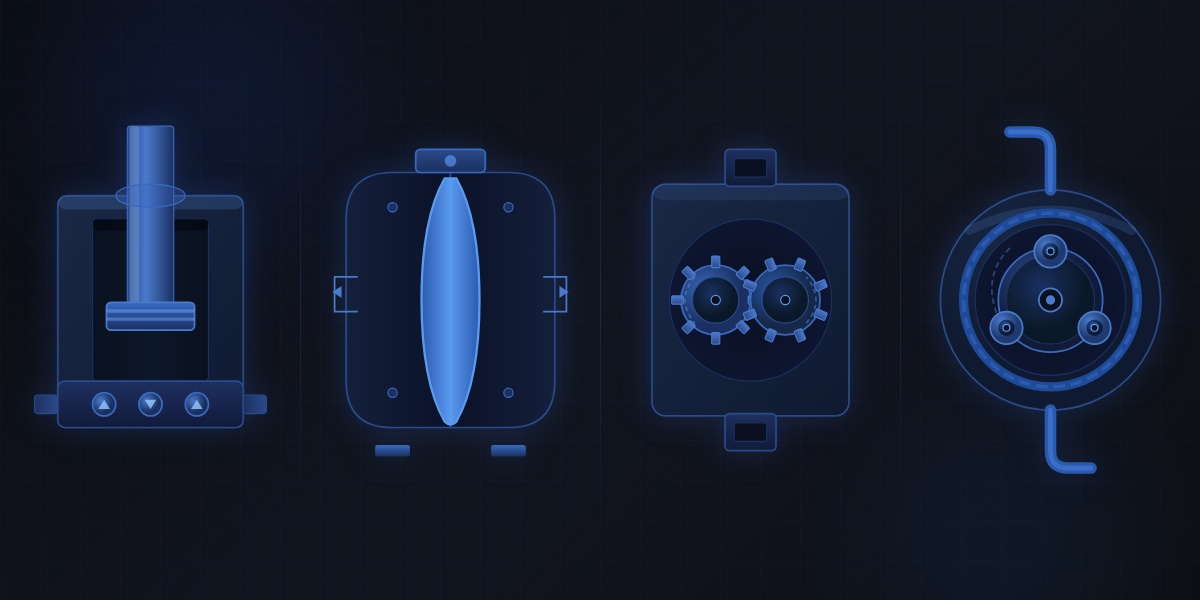
Four cover nearly all metering duty, and pressure plus accuracy narrows it down fast.

  • Solenoid diaphragm. An electromagnet drives the diaphragm directly — no motor, no gearbox. Compact, inexpensive, adjusts electronically, and dominant in municipal water. Pressure ceiling is the constraint, and stroke-length accuracy at the low end of the range is the thing to check.

  • Motor-driven mechanical diaphragm. A motor and eccentric flex the diaphragm. Steadier and better suited to continuous duty than solenoid, with more capacity. The standard choice for plant and facility metering.

  • Hydraulically actuated diaphragm. Hydraulic oil moves the diaphragm instead of a mechanical linkage, which balances the pressure across it and lets the pump reach far higher discharge pressures without tearing diaphragms. This is what most API 675 pumps are, and it's the bridge between metering duty and injection duty.

  • Packed plunger. A plunger displaces directly against the chemical. Highest pressure capability and excellent accuracy, at the cost of packing wear and a plunger surface that has to stay in tolerance. Standard for wellhead and pipeline work.

Peristaltic pumps also meter well and keep the chemical entirely inside a hose, which is worth knowing when containment matters more than pressure — but they're a low-pressure answer.


Which Pump is Best For Chemical Dosing?

For most chemical dosing, a motor-driven diaphragm metering pump is the right answer — it holds accuracy across a usable turndown range, handles continuous duty, and the wetted materials can be matched to almost any chemistry. Move off that default for three reasons, in this order:

  • Pressure. Above a couple hundred psi you're leaving mechanical diaphragm territory. Hydraulic diaphragm or plunger from there up.
  • Chemistry. Aggressive or hazardous chemical pushes you toward a design that isolates the fluid from the drive end, and toward PVDF, PTFE, 316 stainless, or Hastelloy depending on what you're actually running. Confirm against the product data sheet, not the chemical family.
  • Site power and area classification. No power or a Class I Div 1 area, and a pneumatic drive answers the question by itself.

What doesn't belong in chemical dosing is a centrifugal pump. Its flow falls off as back-pressure rises, so the dose moves every time the line does — that's the whole reason positive displacement pumps exist as a category.


When Do You Need a High-Pressure Chemical Pump?

You need a high-pressure chemical pump when discharge pressure exceeds roughly 300 psi — wellhead, flowline, or pipeline injection — because a standard metering pump can't build enough head to land the dose.  Once you're injecting against a wellhead, a pipeline, or anything holding real pressure, you've moved out of metering pump territory and into injection territory — and the pump stops being the hard part. A high-pressure chemical pump will generate enough pressure to overstress standard-wall fittings if the piping around it came off a catalog. Wall thickness, relief valve setting, injection quill rating, and pulsation control all have to be engineered to the same class as the pump.

That's a different build and a different conversation. We cover it in full — including how we spec and build skids for it — on the chemical injection pumps page, and the Turbo Chem skid build is a worked example of what changes above 1,500 psi.


What makes a chemical metering pump lose accuracy in the field?

Metering pumps rarely stop. They drift, and drift doesn't announce itself.

  • No backpressure valve. This is the one we see most and the one people don't expect. If a metering pump discharges into a line with little or no pressure, and there's suction head behind it, chemical siphons straight through — the pump reads normal and you're overdosing badly. A backpressure valve on the discharge, and an anti-siphon device at the injection point, fix it. On any install where the suction tank sits above the injection point, treat it as required, not optional.

  • Check valve fouling. Hypochlorite at the wrong dilution and some scale inhibitors crystallize on valve seats. The valve stops seating cleanly, dose changes, pump keeps running.

  • Vapor lock and off-gassing. Hypochlorite in particular releases gas in the pump head. The pump strokes on a compressible bubble and moves far less chemical than the counter says. Degassing valves and correct suction line routing solve it.

  • Cold-thickened chemical. A polymer or inhibitor that feeds fine in August starves a suction line in January. Viscosity is the spec people forget to check at the low end of the temperature range.

  • Diaphragm and packing wear. Gradual capacity loss with no obvious symptom. On a hydraulic diaphragm pump, a rupture also means chemical in the hydraulic oil.

  • Nobody calibrated it.  Draw-down calibration — pull from a graduated column over a timed interval and compare actual volume against the setting — is the only way you find any of the above before a lab result does.

If a pump is running but the chemistry isn't landing, work the whole path before you condemn the pump: suction, valves, backpressure, quill. We do that diagnosis daily, and the pump is the problem less often than people expect. Our repair, rebuild, and replacement services and preventative maintenance programs both start there.


Metering pump down, or not sure what you need? Talk to Clark.

We spec, source, rebuild, and service chemical metering and injection pumps across Louisiana, the Texas Gulf Coast, Mississippi, and Arkansas. Send us the model number, the chemical, and your pressure and flow range, and we'll tell you whether what you have is right for the job.

📞 Call Clark: 337-252-6487

🌐 Contact: evpmp.co/contact-us


Frequently Asked Questions

Q: Is a metering pump the same as a dosing pump?

Functionally, yes — both are positive displacement pumps that deliver a controlled volume of chemical, and the difference is vocabulary rather than technology. Dosing pump is the more common term in European specifications, laboratory work, and OEM equipment, and it usually implies small additions at low pressure using a solenoid diaphragm or peristaltic design. Metering pump is the term used in North American water treatment and process industries. If a quote uses either word, the number that actually matters is the discharge pressure rating.

Q: Does a higher turndown ratio mean a more accurate pump?

No. Turndown ratio only describes the range a pump can be adjusted across, and quoted on its own it means nothing, because any pump can be turned down toward zero. The figure that matters is the minimum capacity at which the pump still meets its stated accuracy. A pump advertising 1000:1 turndown may hold its accuracy band across only part of that range. Ask the vendor for accuracy at the flow rate you will actually run, not at rated capacity.

Q: Do I need an API 675 pump for chemical dosing?

Not always. API 675 is a purchase specification for controlled volume pumps in petroleum, chemical, and gas service, and it defines the performance a pump must demonstrate — steady-state accuracy, linearity, repeatability, and turndown — along with safety design requirements. Specify it when the dose is contractual, regulated, or tied to process quality, or when your client requires it. For general utility dosing where a few percent of drift costs nothing, a good industrial metering pump without the API stamp is usually the sensible spend.

Q: Can a chemical metering pump run dry without damage?

Most cannot run dry for long without damage. Diaphragm metering pumps tolerate brief dry running better than packed plunger pumps, which rely on the chemical to lubricate and cool the packing and will score the plunger and burn packing quickly without it. The more common problem is not a truly empty tank but a partially starved suction line from a plugged strainer or cold-thickened chemical, which damages the pump slowly while the dose quietly falls off. Low-level shutoff on the tank and a strainer on a maintenance schedule prevent both.

Q: Can a chemical metering pump handle viscous or cold chemical?

Up to a point, and only if the pump was sized for it. Metering pumps are rated on water-like fluid at a specific gravity of 1.0, so heavier or thicker chemical means derating the pump or selecting a different model. Viscosity is also a suction-side problem before it is a pump problem — an oversized suction line, a flooded suction rather than a lift, and a larger strainer usually matter more than the pump itself. Check viscosity at your lowest expected temperature, not at the number on the data sheet.

Q: Does EV Pump repair chemical metering pumps, or only injection pumps?

Both, across manufacturers, and we are not limited to equipment we sold. That covers diaphragm and plunger fluid ends, valve and packing service, drive end repair, and draw-down calibration after the work is done. Where parts are obsolete or lead times are impractical, we can custom machine components back to spec rather than forcing a full replacement. Send us the model number and the chemical you are running and we will tell you whether it is worth rebuilding.


Logo - EV Pump & Equipment (5)

EV Pump & Equipment is a leading provider of high-performance fluid handling solutions, specializing in custom pump systems and comprehensive services for industries like oil & gas, petrochemical, and municipal water. With a deep passion for pumps and a commitment to excellence, we deliver reliable, efficient solutions tailored to meet the unique needs of every client. Our hands-on approach and elite equipment ensure that your operations run smoothly and efficiently, every time.