Skip to the main content.

Who We Are

Trusted to fix what others can’t.

Based in Lafayette and trusted across the Gulf Coast, we bring real-world experience to every job and build long-term trust with the people running it.

Comprehensive Pump & Equipment Solutions

If it rotates, moves fluid, or needs fixing, we’ve got it covered.

From pump repair and rebuilds to custom machining and hard-to-source parts,
we’re the team you call when no one else can figure it out.

"
We believe our impact goes beyond pumps. The energy and industrial sectors are crucial to global development, and we’re proud to contribute with our expertise and broad vision.

- Clark Edwards, Owner

6 min read

How EV Pump Selected a Gear Pump for Aerion's ARM System


EV Pump partnered with Aerion to design and test a gear pump capable of suction-lifting drilling mud across variable densities, viscosities, and solids content with no pit modifications required. The pump, built in collaboration with Desmi/Rotan, was successfully deployed on a Permian Basin rig and has since enabled Aerion to expand ARM installations to additional rigs across the US.

Project Snapshot

1

Pump Type Evaluated Across Multiple Options

Multi-Basin

Design Requirement — Permian, Haynesville & Beyond

0

Pit Modifications Required

Active

Ongoing Collaboration & Deployment


About Aerion

This section introduces Aerion, their focus on fluid and waste management technology in the oilfield, and the specific team and product that brought them to EV Pump.


Who is Aerion and what do they do?

Aerion specializes in fluid and waste management, solids control, surface rentals, and technology services across the energy industry. The team EV Pump worked with is focused on a specific product: the Aerion Real Time Monitoring platform, known as ARM.


What is the ARM system?

ARM is a real-time drilling fluid monitoring platform that captures mud properties at the active pit and transmits them directly to drilling engineers without manual sampling and without human error in the reporting chain. Drilling engineers can see exactly what's happening with their mud at any given moment, from anywhere.

The system sits adjacent to the active pit. To work, it needs a continuous, low-volume flow of mud pulled from the pit, run through the ARM unit where data is captured and recorded, and returned. That requires a pump and getting the pump right is what this project was about.


The Challenge

This section explains the technical constraints Aerion faced in selecting a pump for the ARM system, including suction lift requirements, pit compatibility, fluid variability across basins, and the need for a single solution that could work everywhere.


What made this pump selection difficult?

On paper, the flow requirement is small. ARM doesn't need high volume - it needs a reliable, controlled trickle of mud from the active pit. The difficulty is everything else surrounding that requirement.

The pump had to:

  • Provide suction lift: it sits on top of the pit, not submerged in it

  • Require no pit modifications: nothing that changes for different drilling contractors or pit setups

  • Handle mud across widely varying conditions: different densities, chemical compositions, solids content, and viscosities depending on the basin and the well

  • Operate in high-temperature environments: including the Haynesville, where surface temperatures and fluid temps run high

  • Maintain a small footprint: the ARM system is compact; the pump has to match

  • Have no wires hanging into the pit: submersible options were off the table from the start

The operational goal was a single pump design that could be deployed across all the major US drilling basins without re-engineering for each location.


Why EV Pump

This section covers why Aerion brought EV Pump into the project: prior relationship, willingness to approach the problem critically, and a track record of taking on applications that don't have an obvious off-the-shelf answer.


Why did Aerion call EV Pump?

Aerion had already looked at multiple pump options before reaching out to EV Pump. Nothing had fit. They knew they needed something capable of suction lift across a wide range of fluid conditions, they just weren't sure what type of pump that was.

There was also a relationship. EV Pump's first building was rented from the family that founded Aerion. In the oilfield, those connections matter, and they create a foundation of trust that makes working through a hard design problem a lot easier.

Beyond the relationship, Aerion needed a team willing to look at the application critically, not just recommend the closest catalog option and move on. EV Pump was willing to dig into the problem, test the concept in the yard, and work directly with manufacturers to get the design right.


The Design & Build Plan

This section walks through how EV Pump evaluated pump options, landed on a gear pump in collaboration with Desmi/Rotan, conducted suction lift and viscosity testing, and ultimately delivered a pump that proved out in the field.


How did EV Pump approach the pump selection?

EV Pump evaluated multiple pump types against Aerion's requirements. The selection came down to what the application actually demanded: reliable suction lift, tolerance for solids, low volume output, and minimal complexity.

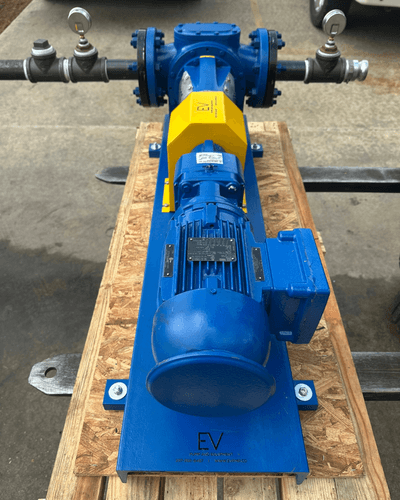
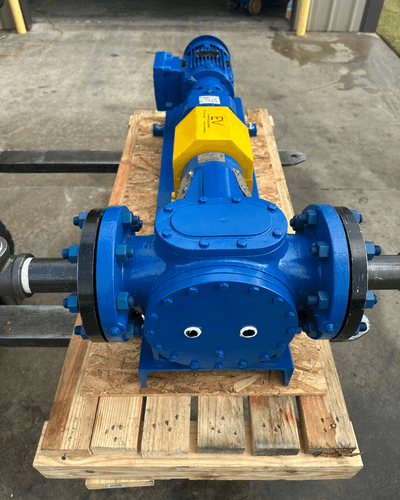
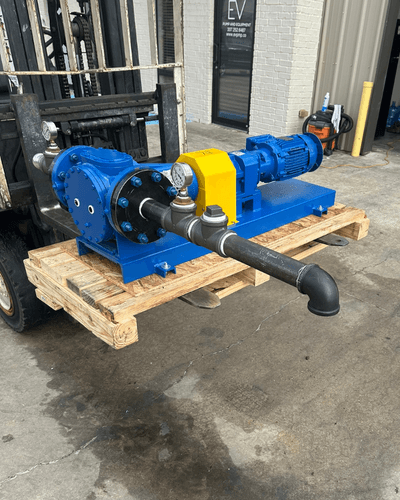
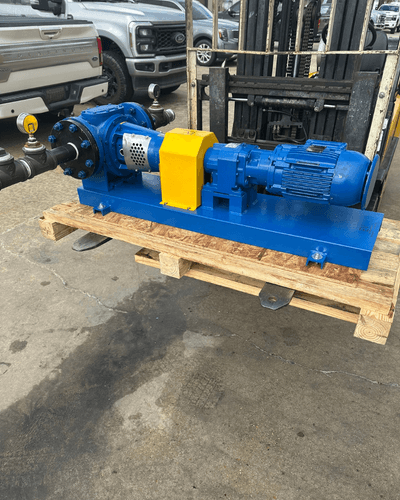
A gear pump checked every box. Gear pumps are simple, robust positive displacement pumps. They generate suction lift without priming hardware, they can be built with wider internal clearances to pass solids, and they don't require anything hanging into the pit to function. The small footprint and low-maintenance design made them a practical fit for a monitoring system that needs to run reliably on a rig with a lot of other things competing for attention.


Who built the pump and how was it designed?

EV Pump worked directly with the team at Desmi/Rotan to design a gear pump specifically for this application. That meant specifying internal tolerances wide enough to handle the solids content found in active drilling mud, and confirming the pump could handle the temperature and chemical range Aerion expected across different basins.

Factory-level collaboration takes more time upfront. It also produces a significantly better result than selecting off the shelf and hoping the specs are close enough.


How did EV Pump test and validate the design?

Before the pump ever saw a rig, EV Pump ran two rounds of validation testing in the yard:

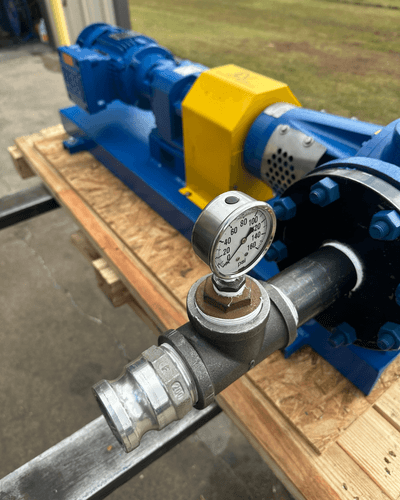
  • Suction lift testing at varying heights to confirm the pump could pull from the pit reliably across the expected installation range.

  • Viscosity testing using low sulfur diesel to evaluate how fluid thickness affects flow rates. Water testing alone significantly underrepresents real-world mud performance.

Both tests passed. The pump was then delivered to Aerion and put into service on a rig in the Permian Basin of West Texas.


Outcomes

This section covers the results: a successful field deployment in the Permian Basin, ongoing ARM expansion to additional rigs, and a close working relationship between Aerion and EV Pump that has continued through the project.


What were the results?

The pump worked. Aerion successfully deployed the ARM system with the gear pump on a Permian Basin rig, proving the concept in a live drilling environment. Since that initial deployment, Aerion has been able to expand ARM installations to additional rigs across the US.

The collaboration between EV Pump and Aerion hasn't stopped at delivery. Both teams have maintained close communication throughout which has allowed smaller issues to get resolved before they became material problems. That kind of ongoing loop between pump supplier and end user is what separates a successful field deployment from one that stalls out after the first installation.


Lessons for Other Operators

This section highlights the broader takeaways: why viscosity testing matters, the value of getting pump suppliers involved early, and how collaborative design relationships lead to better outcomes across the board.


What can other engineers and operators take away from this project?

1. Test with the right fluid. Water is a convenient test medium, but it tells you very little about how a pump will perform with mud, oil, or any higher-viscosity fluid. In this project, switching from water to low sulfur diesel during viscosity testing produced meaningfully different, and more accurate, flow rate data. Test with something that approximates the actual fluid.

2. Get your pump supplier involved early. Aerion brought EV Pump in before the design was locked, not after. That early involvement created time to work with Desmi/Rotan on internal tolerances, run yard tests, and confirm the concept before the system went to the field. Late-stage pump selection usually means compromises. Early involvement means the pump is built for the application.

3. Design for the full operational range, not the average case. The ARM system has to work in the Permian and the Haynesville and every basin in between. Each has different mud weights, temperatures, and chemical profiles. A pump designed only for average conditions will fail at the edges. Build for the range.

4. Ongoing collaboration beats a clean handoff. The relationship between EV Pump and Aerion didn't end at delivery. Staying close through the field deployment allowed both teams to solve problems in real time. A single-rig test is the start of the learning curve, not the end.


Quick FAQs


Logo - EV Pump & Equipment (5)

EV Pump & Equipment is a leading provider of high-performance fluid handling solutions, specializing in custom pump systems and comprehensive services for industries like oil & gas, petrochemical, and municipal water. With a deep passion for pumps and a commitment to excellence, we deliver reliable, efficient solutions tailored to meet the unique needs of every client. Our hands-on approach and elite equipment ensure that your operations run smoothly and efficiently, every time.

What Is a Trash Pump and What Is It Used For?

What Is a Trash Pump and What Is It Used For?

If you’ve ever dealt with floodwaters, muddy pits, or construction site runoff, chances are you’ve come across a trash pump (or wished you had one)....

Read More
What Is a Mud Pump? Uses, Benefits, and Key Applications

What Is a Mud Pump? Uses, Benefits, and Key Applications

Positive displacement pumps aren't the right tool for every job, but when you're moving thick, viscous, or chemically aggressive fluids,...

Read More
Positive Displacement Pumps: Ideal Solution for High-Viscosity Fluids

Positive Displacement Pumps: Ideal Solution for High-Viscosity Fluids

Positive displacement pumps aren't the right tool for every job, but when you're moving thick, viscous, or chemically aggressive fluids,...

Read More