1 min read
Centrifugal Pumps: The Heart of Fluid Handling Systems
Centrifugal pumps are often considered the backbone of fluid handling systems, providing an essential solution for the movement of liquids, gases,...
Based in Lafayette and trusted across the Gulf Coast, we bring real-world experience to every job and build long-term trust with the people running it.
From pump repair and rebuilds to custom machining and hard-to-source parts,
we’re the team you call when no one else can figure it out.
- Clark Edwards, Owner
4 min read
Clark Edwards
:
Updated on August 3, 2026
|
The main parts of a centrifugal pump are the impeller, casing (volute), shaft, bearings, mechanical seal, and wear rings. Each one does a specific job. The impeller generates fluid velocity. The casing converts that velocity into pressure. The shaft and bearings keep the rotating assembly aligned under load, and the mechanical seal and wear rings control leakage and maintain clearance. Get all six working together, and you get efficient, reliable fluid handling, which is why these pumps run in water treatment, oil and gas, and chemical processing. |
.png?width=1000&height=500&name=CROSS-SECTION%20OF%20A%20CENTRIFUGAL%20PUMP%20(1).png)
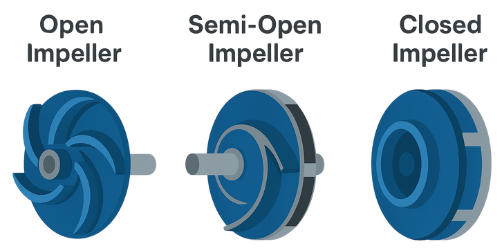
The impeller is a rotating component equipped with vanes or blades. Its primary function is to transfer energy from the motor to the fluid, increasing the fluid’s velocity and pressure. Selecting the appropriate impeller type is crucial for applications like grinder pumps, trash pumps, and diaphragm pumps, ensuring optimal performance and longevity. Depending on the application, impellers come in various designs:

Open impellers have vanes that are attached to a central hub with no shroud (cover) on either side. Because of their simple design and wide passages, they are well-suited to handling fluids containing solids, slurries, or fibrous materials and are commonly found in wastewater treatment and slurry applications.
Advantages:
Less prone to clogging
Easier to clean and maintain
Better for abrasive or viscous fluids
Disadvantages:
Less efficient than closed designs
More wear over time, especially at high speeds
Typically require more frequent maintenance
Applications:
Open impellers are ideal for:
Trash pumps handling debris-heavy water
Grinder pumps used in wastewater systems
Diaphragm pumps transferring slurries or corrosive fluids
Slurry transfer in mining or construction
Industrial processes with solid-laden fluids
Semi-open impellers have a shroud on one side, usually the back, while the other side is open. This design offers a balance between solid-handling capability and hydraulic efficiency.
Advantages:
Good compromise between open and closed impeller designs
Can handle some suspended solids
Improved efficiency over open impellers
Easier to manufacture and maintain than closed impellers
Disadvantages:
Still less efficient than fully closed designs
Requires tight clearance control between the impeller and casing
Applications:
Semi-open impellers are commonly used in:
Chemical processing and fluid handling systems
Pumps moving liquids with moderate solids content
Well servicing when small particles or debris are present
Light sludge or mud transfer
Closed impellers are fully enclosed with shrouds on both sides of the vanes. This design is the most efficient and commonly used in clean fluid applications where solids are not a concern. Best for clean liquids, providing high efficiency and reduced wear.
Advantages:
Highest efficiency of the three types
Ideal for high-flow and high-pressure systems
Reduced wear and longer lifespan in clean environments
Disadvantages:
Cannot handle solids or fibrous materials
More difficult to clean and repair
Requires tight tolerances and higher manufacturing cost
Applications:
Closed impellers are found in:
Centrifugal pumps for municipal water, HVAC, and clean chemical transfer
Webtrol pumps for booster applications
Fluid processing equipment in sanitary or controlled environments
Horizontal directional drilling systems using clean drilling fluids
A cross-section of an impeller cuts through the component to show the internal structure - the vanes, the eye (inlet), the shroud, and the hub. Looking at a labeled cross-section is one of the fastest ways to confirm which impeller type you're dealing with (open, semi-open, or closed) and to catch wear, erosion, or clearance problems between the impeller and the casing before they lead to failure. Keep a labeled diagram with your inspection paperwork, and routine checks go faster and stay consistent.
.png?width=800&height=400&name=Website%20Images%20-%20EV%20Pump%20(1).png)
The casing, often designed as a volute, surrounds the impeller and serves multiple purposes:
Fluid Containment: It houses the fluid being pumped, maintaining system pressure.
Energy Conversion: The volute design gradually expands, converting the fluid’s kinetic energy into pressure energy, facilitating efficient fluid discharge.
Proper casing design is vital in applications like horizontal directional drilling and fluid processing equipment, where precise fluid control is essential.
The shaft connects the impeller to the motor, transmitting mechanical energy. Bearings support the shaft, allowing smooth rotation and reducing friction. Key considerations include:
Alignment: Proper shaft alignment prevents vibrations and wear.
Bearing Selection: Choosing the right bearings ensures durability, especially in demanding environments like well pump replacement, Hydra-Trech pump operations, or systems that incorporate positive displacement options such as gear pumps. Gear pumps are ideal for transferring viscous fluids at consistent flow rates, and their compact, durable design makes them a reliable solution in applications where centrifugal pumps may not perform efficiently.
Regular maintenance of these parts of a pump is crucial for the longevity of pump and equipment systems.
Because components like bearings, seals, and wear parts experience predictable wear, many operators keep these items stocked as critical spares to avoid downtime. If you’re building out your own spare-parts plan, here’s a full guide on what to keep on hand and why it matters: Critical Spares: What Should You Keep On Hand for Your Pump System?
Beyond the primary parts, several other components play significant roles:
Mechanical Seals: Prevent fluid leakage along the shaft.
Wear Rings: Maintain efficiency by minimizing leakage between the impeller and casing.
Stuffing Box: Houses the packing material, providing a seal around the shaft.
These centrifugal pump components are integral in various applications, ensuring reliable and efficient fluid handling solutions. For more information about c-pumps, check out these 12 types of centrifugal pumps and their applications!
Read our blog for more information on centrifugal pumps compared to other common pump types.
Whether dealing with webtrol pumps, grinder pumps, or trash pumps, knowledge of these components aids in making informed decisions, optimizing performance, and extending equipment lifespan. Keeping a checklist of essential centrifugal pump parts on hand also helps reduce downtime during repairs.
For specialized fluid handling equipment and solutions tailored to your needs, consult with experts who can guide you through the selection and maintenance processes for either rental equipment or purchasing your own.
Q: What are the main centrifugal pump parts?
The main parts are the impeller, casing (volute), shaft, bearings, mechanical seal, and wear rings. The impeller adds velocity to the fluid, the casing converts that velocity into pressure, and the remaining parts support rotation and control leakage and clearance.
Q: What does the impeller do?
The impeller is the rotating component that transfers energy from the motor to the fluid. Its vanes increase fluid velocity, which the casing then converts into pressure to move fluid through the system.
Q: What is a cross-section of a pump impeller?
A cross-section is a cutaway view showing the impeller's internal structure, including the vanes, eye (inlet), shroud, and hub. It helps identify impeller type (open, semi-open, closed) and spot wear or clearance issues.
Q: What are centrifugal pump wear parts?
Wear parts are components that see the most friction and erosion, primarily wear rings, mechanical seals, bearings, and impeller vanes. They're commonly stocked as spares since they wear predictably.
.png?width=151&height=80&name=Logo%20-%20EV%20Pump%20%26%20Equipment%20(5).png)
EV Pump & Equipment is a leading provider of high-performance fluid handling solutions, specializing in custom pump systems and comprehensive services for industries like oil & gas, petrochemical, and municipal water. With a deep passion for pumps and a commitment to excellence, we deliver reliable, efficient solutions tailored to meet the unique needs of every client. Our hands-on approach and elite equipment ensure that your operations run smoothly and efficiently, every time.
1 min read
Centrifugal pumps are often considered the backbone of fluid handling systems, providing an essential solution for the movement of liquids, gases,...
1 min read
Centrifugal pumps show up in more places than most people realize, from the water coming out of your tap to the fluid systems keeping an...
1 min read
Centrifugal pumps are the workhorses of fluid handling systems, moving everything from liquids and gases to slurries with impressive efficiency. If...